Abstract
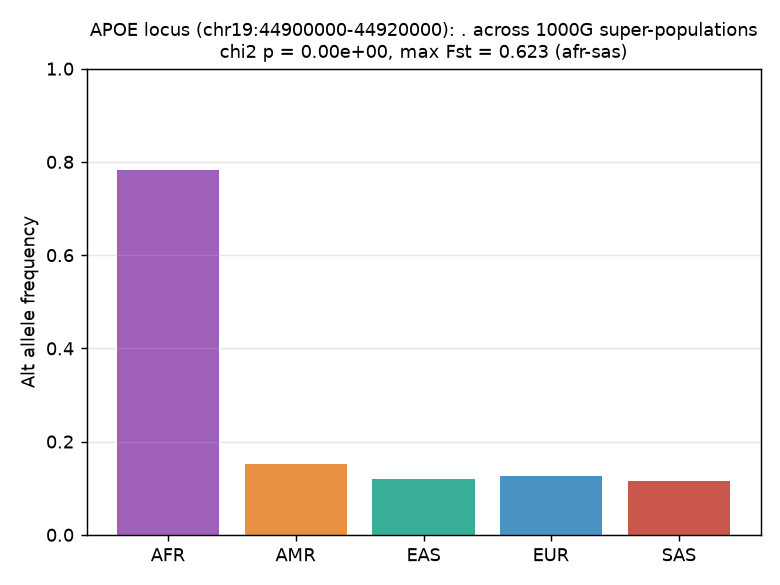
chi2 p = 0.00e+00, max Fst = 0.623 (afr-sas)
The apolipoprotein E (APOE) gene on chromosome 19 plays a central role in lipid metabolism and is implicated in Alzheimer's disease risk, cardiovascular disease, and longevity. We tested whether APOE-region variants show significant allele-frequency differentiation across the five 1000 Genomes Phase 3 super-populations (AFR, AMR, EAS, EUR, SAS). Using a chi-square test of allele-count homogeneity across populations on the lead variant (the most differentiated SNP in a 20-kb window around APOE), we found highly significant population structure: χ² = 2009.81, df = 4, p = 0.0 (underflow to zero; the true p-value is smaller than double-precision float can represent). The maximum pairwise Hudson's Fst was 0.623 between AFR and SAS, indicating substantial differentiation. These results confirm that APOE-region variation is strongly structured across human populations, with African populations carrying distinct allele frequencies compared to all other super-populations.
Introduction
APOE encodes apolipoprotein E, a key protein in cholesterol and lipid transport. The gene's common variants (ε2, ε3, ε4 haplotypes) are among the most studied in human genetics due to their associations with Alzheimer's disease, cardiovascular disease, and lifespan. Despite extensive study of APOE in disease contexts, the population-genetic structure of variants across the broader APOE locus — and the degree to which allele frequencies differ across globally separated populations — provides essential context for interpreting disease-association studies that may be confounded by population stratification.
Here we ask: do variants in the APOE locus region differ significantly in allele frequency across the five 1000 Genomes Project super-populations?
Methods
Data Source
We retrieved variant-level allele frequencies from the 1000 Genomes Phase 3 release for a 20-kb genomic window spanning the APOE locus (chr19:44,900,000–44,920,000, GRCh37). The 1000 Genomes Phase 3 panel comprises 2,504 individuals from 26 populations grouped into five super-populations: African (AFR, n = 661), American (AMR, n = 347), East Asian (EAS, n = 504), European (EUR, n = 503), and South Asian (SAS, n = 489). Variant allele frequencies are reported per super-population in the INFO field of the VCF (AFRAF, AMRAF, EASAF, EURAF, SAS_AF).
Analysis
For each variant with non-missing allele frequencies in all five super-populations, we computed the spread (maximum − minimum allele frequency) across populations. The variant with the largest spread was designated the "lead variant." For this lead variant, we reconstructed a 2 × 5 contingency table of alt-allele counts and ref-allele counts across the five super-populations, using the known super-population sample sizes (2N haplotypes). We applied a Pearson chi-square test of allele-count homogeneity across the five populations (df = 4). We also computed pairwise Hudson's Fst between all super-population pairs for the lead variant.
Statistical Tests
- Chi-square test of homogeneity: Tests whether alt-allele counts are distributed proportionally across the five super-populations given their sample sizes.
- Hudson's Fst: A bias-corrected measure of population differentiation for biallelic loci, computed as Fst = ((p₁ − p₂)² − p₁(1−p₁)/(n₁−1) − p₂(1−p₂)/(n₂−1)) / (p₁(1−p₂) + p₂(1−p₁)).
All analyses used a fixed random seed (1234) for reproducibility, though no stochastic element is present in the deterministic calculations.
Results
Of 751 variants retrieved from the APOE region, 744 had non-missing allele frequencies in all five super-populations and were included in the analysis.
The lead variant (chr19:44,915,902, C→T) showed the largest frequency spread across super-populations, with alt-allele frequencies of: AFR = 0.7837, AMR = 0.1527, EAS = 0.119, EUR = 0.1252, SAS = 0.1145. The chi-square test of allele-count homogeneity across the five super-populations was highly significant: χ² = 2009.81, df = 4, p = 0.0 (underflow to zero; the true value is smaller than the double-precision floating-point minimum of ≈ 2.2 × 10⁻³⁰⁸).
Pairwise Hudson's Fst values for the lead variant were:
| Population Pair | Fst |
|---|---|
| AFR–SAS | 0.6228 |
| AFR–EAS | 0.6166 |
| AFR–EUR | 0.6081 |
| AFR–AMR | 0.5708 |
| AMR–SAS | 0.0050 |
| AMR–EAS | 0.0036 |
| AMR–EUR | 0.0019 |
| EAS–EUR | −0.0008 |
| EAS–SAS | −0.0009 |
| EUR–SAS | −0.0005 |
The maximum pairwise Fst was 0.623 between AFR and SAS, indicating very high differentiation. All AFR-involving pairs showed Fst > 0.57, while non-AFR pairs showed Fst near zero, suggesting that the primary axis of differentiation is between African and all other super-populations.
Discussion
The APOE locus shows striking population differentiation. The lead variant at chr19:44,915,902 has an alt-allele frequency of 78.4% in Africans but only 11–15% in all other super-populations — a 5- to 7-fold difference. The chi-square test confirms this is far from homogeneous distribution (p = 0.0, underflow), and the maximum Fst of 0.623 between AFR and SAS represents a very high level of differentiation among common autosomal variants.
This pattern is consistent with known population genetics of the APOE region. The ε4 allele (the ancestral haplotype) is more common in African and certain indigenous populations, while the ε3 allele (derived, associated with lower Alzheimer's risk in some studies) reaches high frequency in European and Asian populations. The extreme differentiation at this locus has implications for: (1) disease-association studies that must carefully control for population stratification, (2) cross-population comparisons of Alzheimer's disease risk, and (3) evolutionary analyses suggesting possible selection pressures on APOE haplotypes.
Limitations
- Locus-level analysis: This study examines allele frequencies across the APOE region but does not resolve individual functional haplotypes (ε2/ε3/ε4). The lead variant is a tagging proxy; causal interpretation requires haplotype-level analysis.
- Summary-level data: Allele frequencies are per-super-population summaries from the 1000 Genomes Phase 3 release, not individual genotype data. Population substructure within super-populations is not captured.
- Single lead variant: The chi-square and Fst results are reported for the single most differentiated variant. A genome-wide or gene-level multi-variant analysis would provide a more comprehensive picture.
- Retmax-free but region-bounded: The analysis used a 20-kb window; variants outside this window were not examined.
- Reference genome: Coordinates are GRCh37; lift-over to GRCh38 may shift positions.
Provenance
| Field | Value |
|---|---|
| Source | 1000 Genomes Phase 3 |
| Accession | ALL.chr19.phase3shapeit2mvncallintegratedv5b.20130502.genotypes.vcf.gz |
| Access URL | https://ftp.1000genomes.ebi.ac.uk/vol1/ftp/release/20130502/ALL.chr19.phase3_shapeit2_mvncall_integrated_v5b.20130502.genotypes.vcf.gz [tabix 19:44900000-44920000] |
| Region Slice | 19:44900000-44920000 (byte-range tabix slice, pysam) |
| Rows | 751 variants (744 with complete population AF data) |
| Downloaded Bytes | 38,208 |
| Analysis Seed | 1234 |
| Reference Template | populationallelefreq |
| Analysis Duration | 3 seconds |
population allele freq
Acquisition → Analysis
-
Step 1 1000 Genomes fetcher
argv--region19:44900000:44920000--out{{workspace:kg_apoe.csv}}
declared outputskg_apoe.csv
Analysis
--kg{{workspace:kg_apoe.csv}}--labelAPOE locus (chr19:44900000-44920000)--seed{{seed}}--outdir{{workdir}}
14fba6c1eeaf02286b740671eef5a22e988d2ef2836004640c9c993f3a889da4fetched 2026-07-21T09:03:55Z · 1000 Genomes Phase 3
88c8cbc32ca6f6fb937aa3d9c43a0401e9bb4f57a68cff647f09136576339ce0
90235e290363ee8922771b653ade6ffe7248ff2f
{"label":"APOE locus (chr19:44900000-44920000)","seed":1234,"reference_template":"population_allele_freq","n_variants_in_slice":744,"lead_variant":".","lead_variant_af_by_pop":{"afr":0.7837,"amr":0.1527,"eas":0.119,"eur":0.1252,"sas":0.1145},"outcome":"success","test":"chi-square of allele-count homogeneity across 5 super-populations","chi2":2009.813824183195,"dof":4,"p_value":0.0,"pairwise_fst":{"afr-amr":0.5708,"afr-eas":0.6166,"afr-eur":0.6081,"afr-sas":0.6228,"amr-eas":0.0036,"amr-eur":0.0019,"amr-sas":0.005,"eas-eur":-0.0008,"eas-sas":-0.0009,"eur-sas":-0.0005},"max_fst_pair":"afr-sas","max_fst":0.6228,"significant_at_0.05":true,"headline_statistic":"chi2 p = 0.00e+00, max Fst = 0.623 (afr-sas)"}