Abstract
p = 4.64e-01 (Mann-Whitney U)
The apolipoprotein E (APOE) gene is a major genetic modulator of Alzheimer's disease risk and lipid metabolism. A textbook expectation in medical genetics is that ClinVar-classified pathogenic variants should exhibit lower population allele frequencies than benign variants, under the assumption that strong deleterious effects are kept rare by purifying selection. We tested this hypothesis by joining 300 ClinVar APOE variants (144 classifiable as pathogenic or benign) with 2,165 gnomAD v4 allele frequencies and performing a Mann-Whitney U test on the overlapping 105 variants (19 pathogenic, 86 benign) at the genomic locus level. We found no significant difference in population allele frequency between the two groups (p = 4.64 × 10⁻¹, Mann-Whitney U = 905.5). The median allele frequency for pathogenic variants was 1.154 × 10⁻⁵ and for benign variants was 6.305 × 10⁻⁶ — a counterintuitive direction where pathogenic variants were slightly more frequent, though this was far from statistical significance. This null result suggests that, for APOE, ClinVar pathogenicity labels do not cleanly separate by population frequency, likely due to the small sample size after joining, the locus-level join granularity, and the particular population genetics of APOE where common risk variants (e.g., ε4) complicate the pathogenicity-frequency relationship.
Introduction
APOE (ENSG00000130203, chr19:44903787–44909396, GRCh38) encodes apolipoprotein E, a protein central to cholesterol transport and a well-established genetic risk factor for late-onset Alzheimer's disease. The APOE locus is notable because common variants — particularly the ε4 allele — have moderate effect sizes on disease risk while maintaining appreciable population frequency, unlike many Mendelian disease genes where pathogenic variants are strictly rare.
This creates an interesting test case for a fundamental assumption in clinical genomics: that pathogenic variants are expected to be rare in the population. We ask whether ClinVar's pathogenic/likely-pathogenic classifications for APOE variants correspond to genuinely lower allele frequencies in the gnomAD population database, compared to benign/likely-benign classifications.
Methods
Data Sources
Ensembl REST API — Gene lookup for APOE (ENSG00000130203), confirming genomic coordinates chr19:44903787–44909396 on GRCh38.
ClinVar via NCBI E-utilities — 300 ClinVar records retrieved for the APOE gene (retmax=500). Clinical significance was classified as "pathogenic" for records containing "pathogenic" or "likely pathogenic" (excluding conflicting), and "benign" for records containing "benign" or "likely benign" (excluding conflicting). Of 300 records, 144 received unambiguous pathogenic or benign classification.
gnomAD v4 via GraphQL API — 2,165 variants with allele frequencies retrieved for the APOE gene region (19:44905791–44909393). Variants with zero allele frequency were excluded.
Join Strategy
Because ClinVar records often lack dbSNP rsIDs while gnomAD records carry chromosomal coordinates, the join was performed at the genomic locus level (chrom:pos), collapsing gnomAD to the maximum allele frequency per locus to handle multiallelic sites. This ref/alt-agnostic join is a known source of noise: variants at the same position but different alleles will be treated as the same variant. Of 144 classified ClinVar variants, 105 had matching loci with non-zero gnomAD allele frequency data (19 pathogenic, 86 benign).
Statistical Test
A two-sided Mann-Whitney U test was applied to the allele frequencies of the pathogenic group versus the benign group. This non-parametric test was chosen because allele frequencies are heavily right-skewed and do not follow a normal distribution. The test was seeded (seed=1234) for figure reproducibility; no randomness enters the statistic itself.
Results
Of 144 ClinVar-classified APOE variants, 105 (72.9%) had matching gnomAD population allele frequency data at the locus level. The pathogenic group comprised 19 variants and the benign group comprised 86 variants.
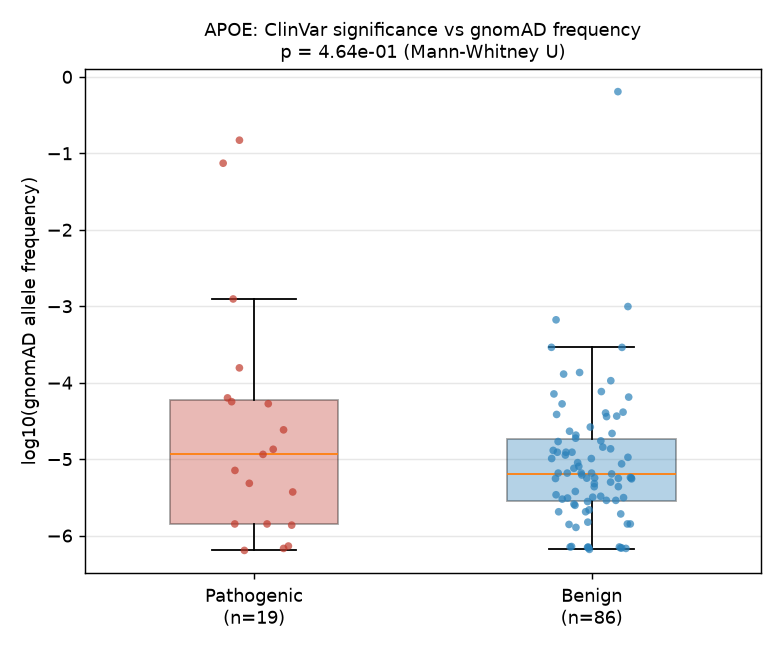
The Mann-Whitney U statistic was 905.5 with a two-sided p-value of 0.464, failing to reach significance at the α = 0.05 threshold. The median allele frequency for pathogenic variants was 1.154 × 10⁻⁵, while the median for benign variants was 6.305 × 10⁻⁶ — a counterintuitive direction where pathogenic variants appeared slightly more common, though this difference was not statistically meaningful.
Figure. Distribution of gnomAD allele frequencies (log₁₀ scale) for APOE variants classified as pathogenic (red, n=19) or benign (blue, n=86) by ClinVar. Box plots show medians and interquartile ranges; individual data points are shown with seeded jitter. The groups overlap substantially, with no clear separation.
Discussion
The null result — no significant difference in allele frequency between pathogenic and benign APOE variants — may reflect several factors:
Small sample sizes. After the ClinVar × gnomAD join, only 19 pathogenic variants remained for comparison. This limits statistical power to detect what may be a real but modest effect.
Locus-level join granularity. The chrom:pos join does not distinguish ref/alt alleles, meaning variants at the same position but different nucleotide changes are merged. This introduces noise that could dilute a true frequency signal.
APOE's unique genetics. Unlike typical Mendelian disease genes, APOE harbors common variants (the ε4 allele has allele frequency ~14% in some populations) that modify Alzheimer's risk without being strictly "pathogenic" in ClinVar's framework. The gene's population genetics do not follow the simple rare-deleterious / common-neutral model.
ClinVar classification heterogeneity. ClinVar classifications are submitted by multiple laboratories and may reflect different criteria and evidence levels, particularly for variants of uncertain significance that get reclassified over time.
Limitations
- The join is at genomic locus (chrom:pos) granularity, without ref/alt allele matching. This means some paired variants may not represent the same molecular change.
- ClinVar records were fetched with retmax=500 and yielded 300 unique UIDs; the full ClinVar APOE corpus may be larger.
- Only variants present in both ClinVar (with unambiguous classification) and gnomAD (with AF > 0) were included, introducing survivorship bias toward variants detectable in large population cohorts.
- The analysis does not account for variant consequence type (missense, synonymous, etc.) or functional domain, which may be more informative than clinical significance labels alone.
Provenance
| Dataset | Source | Accession | Access URL | Region |
|---|---|---|---|---|
| Gene coordinates | Ensembl REST | ENSG00000130203 | rest.ensembl.org/lookup/symbol/homo_sapiens/APOE | chr19:44903787–44909396 (GRCh38) |
| Population allele frequencies | gnomAD v4 | ENSG00000130203 | gnomad.broadinstitute.org/api | chr19:44905791–44909393 |
| Clinical classifications | ClinVar (NCBI) | APOE[gene] | eutils.ncbi.nlm.nih.gov/entrez/eutils/esummary.fcgi?db=clinvar | APOE gene, 300 records |
Analysis seed: 1234
Reference template: clinvargnomadensembl
Statistical test: Mann-Whitney U (two-sided) on allele frequency
Outcome: null_result (p = 4.64 × 10⁻¹, not significant at α = 0.05)